
Start with completed sales of land a buyer would compare with yours. Charleston County has property-record and sales-date tools, but you still need to check what each price covered. A small lot, a wooded tract and land beside a marsh may appeal to different buyers. Use suitable sales to build a range rather than relying on one county-wide average.
Find the parcel before looking at prices
Keep a tax bill or your deed nearby. A parcel number is the county’s ID for a piece of land. Charleston’s search calls it TMS. List each number if you plan to sell several pieces, and note the acres you believe you own.
The county’s Property Record Cards search offers name, address and parcel searches. Its notice directs current ownership information and ownership history to the newer Tax Site linked there. Follow that notice when checking who is listed now. Do not assume an older screen is the latest ownership record.
The county’s search help says to enter a parcel ID without dashes or spaces. For an address search, try the street name without a street type such as “Road.” If you still cannot find the land, ask the county for help rather than choosing a nearby result.
Use the sales-date search to find leads
The Search By Sales Date page has from-and-to dates, a street name field and a subdivision field. A subdivision is a named area of lots. The form says you can use the first part of its name for a wider search. Save the dates and location terms you use.
Treat the results as possible comparisons. Check the parcel, sale date, acres, full price and buildings. If a result is unclear, ask an agent to help confirm what the deal included. A recorded transfer may not be a useful sale to compare with your land.
Keep ownership research separate from price research. You may need the current Tax Site to check who owns a parcel and the sale record to understand an older deal. Connect both to the same parcel number.
Choose properties a buyer would compare
Ask a local land agent for completed sales and the reason each one fits. Compare size, location, road entrance, open ground, woods, slope and known services. Keep vacant land separate from land with a house.
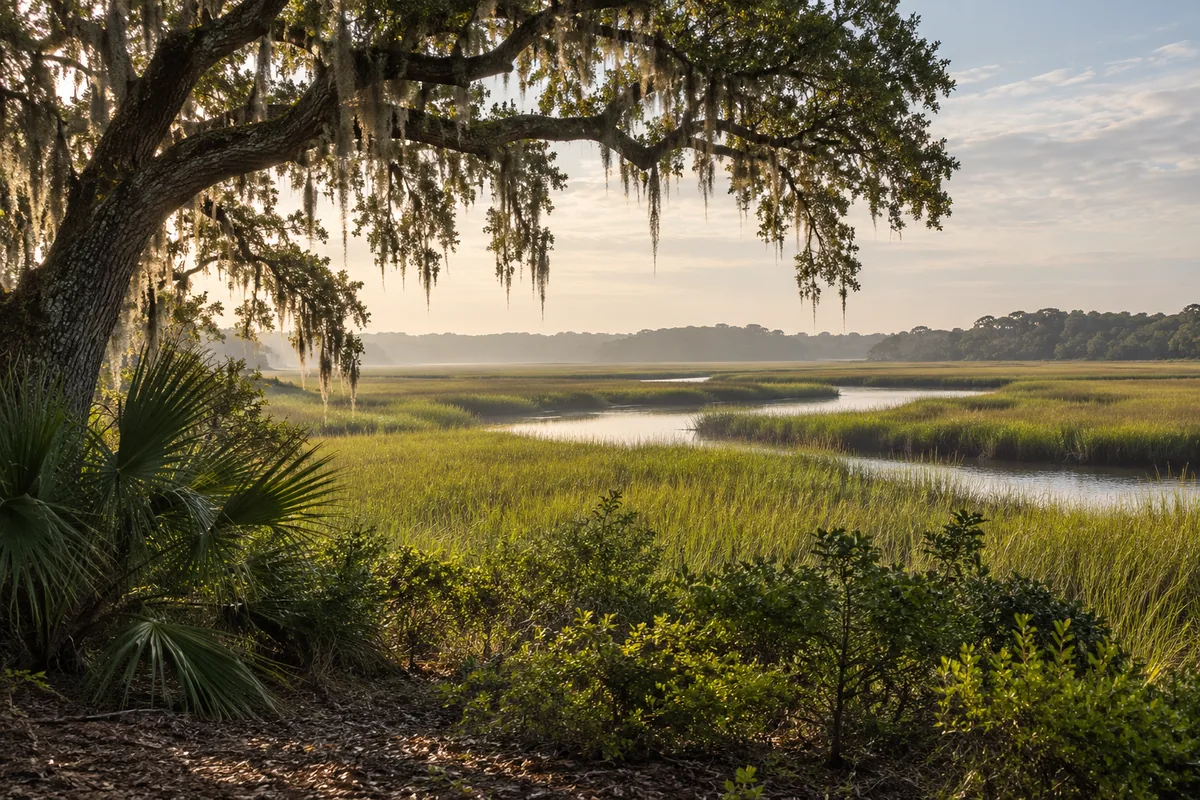
Do not assume every acre in a coastal property has the same use or value. If your land includes marsh or other wet ground, explain what you know and what remains uncertain. Ask which sales truly fit those features. Being near water does not by itself prove that a buyer can build or use the land in a certain way.
A small lot with nearby services can attract different buyers from a larger rural tract. Note those differences in your comparison. If nearby matches are scarce, ask whether older sales or a wider area would help. An agent should explain the limits of that wider search.
Keep one row for each complete deal
Write the date, parcel numbers, deed reference, total acres, full price and buildings in one row. A deed is the paper used to transfer ownership; its reference helps someone locate the recorded document. Check whether several pieces sold together.
Here is a made-up example: 3 acres and 7 acres sell together for $150,000. That is 10 acres at $15,000 per acre. Dividing the full price by only 3 acres would mislead you. These are not Charleston County sales or an estimate of your property’s value.
Do not count repeated ads as separate deals. Do not substitute a tax value for a missing sale price. If a sale included a house, ask how useful it is for your vacant land; subtracting the house’s tax value does not confirm a separate land price.
Have a short note ready for an agent or buyer
Gather your tax bill, deed and any survey, lease or road agreement. A survey shows land lines. Note how you reach the land and whether someone else uses it. Include old test results or permits with their dates if you have them.
You can begin asking about selling without ordering every report. Ask what a new test or survey would answer and who would pay. Keep unknown facts as questions. A buyer’s plan for the land needs its own checks before you make promises.
If you are helping settle a loved one’s estate or several people own the land, ask a closing professional who needs to sign. Start with the papers you have. The Charleston County seller guide covers the wider selling process.
Compare written offers, costs and timing
You can use an agent, find a buyer yourself or compare a direct offer. Ask an agent about pricing, advertising and fees. Selling yourself brings more calls and visits to handle. Ask a direct buyer which checks remain and what costs you pay.
Compare price, costs, loan payoff, taxes, deposit, target closing date and when the buyer can cancel. A made-up $110,000 offer with $9,000 in costs leaves $101,000 before loans and taxes. A $106,000 offer with $3,000 in costs leaves $103,000. These are not local prices or Reelvest offers.
Get a written estimate and have unclear agreement terms explained before signing. Our land offer worksheet helps you keep the numbers together. If you want a direct offer to compare, tell Reelvest about your land.
Questions About Charleston County Land Value
Where should I check current ownership information?
The county’s Property Record Cards site directs current ownership and ownership history to the newer Tax Site linked from its page. Use the same parcel number to connect the records.
What if my parcel number search finds nothing?
Check that you copied the number correctly. The county’s search help says to leave out dashes and spaces in the parcel ID field. Ask the county for help if you still cannot find the land.
Can I use any nearby sale as a comparison?
Choose similar land and confirm what the price covered. Buildings, parcel size, services and wet or marsh ground can make nearby properties poor matches. Ask a local land agent to explain each choice.
Are the old March tables confirmed market prices?
No. The tables were not checked against unique parcels and deeds and have been removed. Research suitable completed sales using official records instead.
Local source links reviewed October 6, 2026.