
Price your land by comparing recent completed sales of the same kind of ground. For a field, look at the usable acres, entrance and farm agreements. For a small lot, check the road and services. A price per acre alone misses those details.
Start with the right Huron County land record
Find a tax bill or deed and copy the land ID and acres. Note the closest road and every piece you plan to sell. A land ID is the number used to identify one piece of land.
The Huron County, Ohio Auditor says to begin with Search or QuickSearch at the top of its site. Use the result to check that your notes point to the right land. If you need help, call 419-668-4304. The office is at 12 East Main Street, Suite 300, in Norwalk.
The site warns that its map lines do not establish ownership. Use them to find your way around the record, not to promise a buyer an exact boundary. Keep your deed and any survey with your price notes.
For a field, separate total acres from usable ground
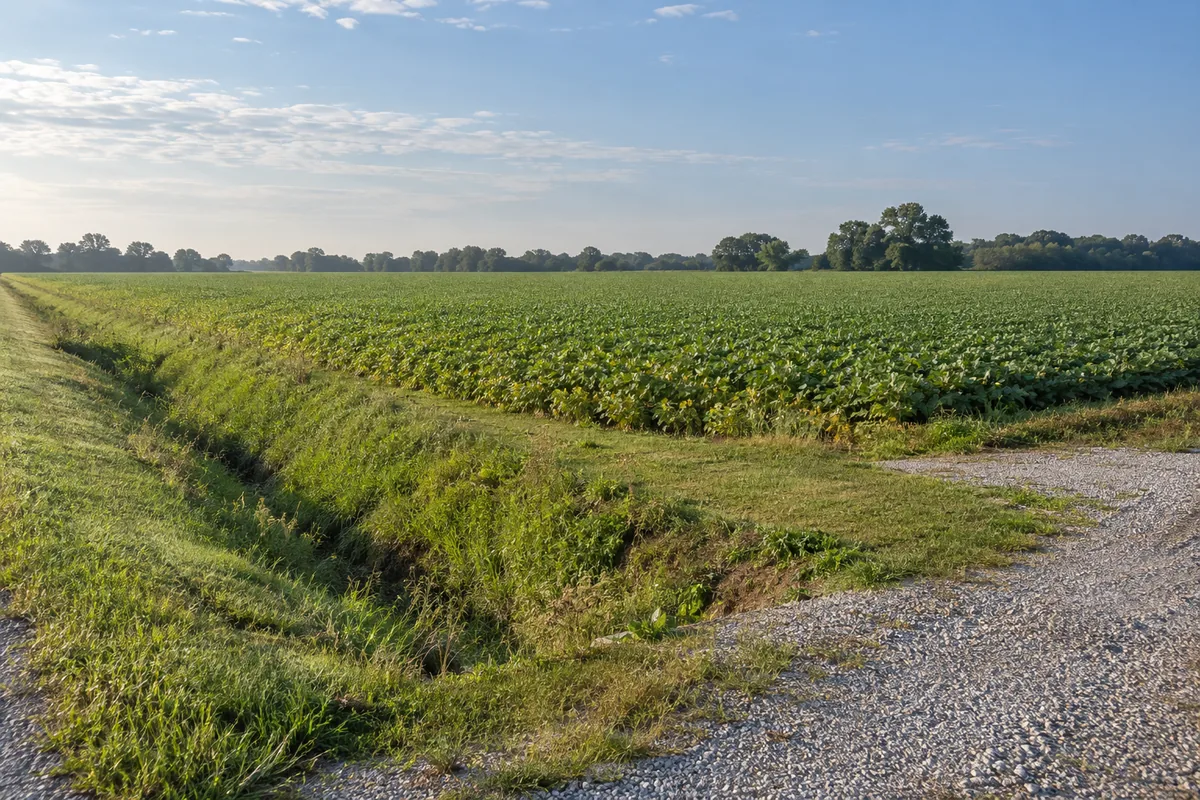
A tax record’s total acres may include more than the ground someone can farm. Walk through what you know: open field, woods, lane, ditch and areas that stay wet. Mark questions you cannot answer yet.
- Entrance: Where does equipment enter? Do you have papers for a route across other land?
- Drainage: What have you seen after rain? Do you have any old drainage plans to share?
- Current use: Is someone farming or renting the ground? Save the agreement you have.
- Other parts: Does the sale include a barn, house or a separate piece of land?
You don’t need to invent a value for each part. These notes help your agent choose fair matches and explain why two fields may sell for different amounts.
For a small lot, ask different price questions
Start with sales of similar-sized lots in a similar location. A large farm sale can be poor support for a small lot’s price, even if both are in Huron County.
Write down whether water, sewer or power is connected, available nearby or still unknown. Nearby lines are not the same as a checked connection. Keep any service or building papers you already have.
If a buyer wants a home site, don’t promise it is ready to build because it appears on a map. Ask the local office responsible for that land what still needs to be checked. Your price discussion should separate known features from a buyer’s future plans.
Ask for checked sales, not just ads
A local land agent can help find recent completed deals for your kind of property. Ask for the sale date, full price, total acres and all land IDs. Also ask what buildings or other tracts came with the sale.
Keep each deal on one row. A farm sold as several pieces may appear under several addresses. Counting those entries separately can make a small set of sales look larger than it is.
Save advertised prices in a separate list. They can show what sellers are asking, but they do not prove what a buyer paid. If a sale’s details cannot be checked, don’t use it as the main reason for your price.
Make a short price comparison
| Keep in your notes | Question to answer |
|---|---|
| Date, full price and sale reference | Was this a completed sale? |
| All land IDs and acres | What did the buyer get? |
| Field, lot, entrance and services | Is it the same kind of land? |
| Buildings and open questions | What makes it different from mine? |
Here is a made-up example. A 40-acre deal for $400,000 works out to $10,000 per acre. If it included a house and barn, that figure is not the price of 40 empty acres. These are teaching numbers, not Huron County sales.
Ask your agent for a starting range and the best reasons for it. Keep the tax value and its date separate. If you need a formal value for a specific purpose, ask about an appraisal and its cost.
Compare selling choices after you have a starting range
You can use an agent, sell the land yourself or ask a direct buyer for an offer. Compare the time, work and seller costs, not just the top price.
Ask each buyer for a written price, planned closing date, costs you pay and reasons they can cancel. Check the money you keep after costs and any loan or tax balance. Use our offer comparison worksheet to put the choices side by side.
The Ohio land seller guide covers general sale steps. If you’d like a direct Reelvest offer, tell us what you know about your land. You decide whether to move forward.
Questions About Huron County Land Value
Can I use a farm’s price per acre for a small lot?
Choose sales that fit your land’s size, location and use. Small lots and farm fields can have different buyers, services and costs. A per-acre number alone does not make them fair matches.
Do the county map lines prove my boundaries?
No. The Huron County Auditor warns that its map lines do not establish ownership. Keep the deed and any survey, and ask your closing team what needs to be checked.
What if someone rents my field?
Save the agreement and explain what you know about its timing and use. Ask how it affects the sale before making promises to a buyer.
Should I use only the number on my tax bill?
Keep that value and its date as a separate note. Use checked recent sales of similar land to discuss a selling range with a local land agent.
Local source links reviewed October 6, 2026.