
Start with recent completed sales of land like yours in Liberty County, Florida. Match the acres, way in, ground and included buildings. Check the deed and parcel details before using a price to discuss a selling range. A county average alone cannot tell you what your land will bring.
Start With What You Know
Find a tax bill, deed or old survey. Write down the acres, land number and nearest road. The land number is the county’s number for your piece of land. List each one if your sale would include several pieces.
Make a short note about what you’re selling. Is it wooded or open? How do you reach it? Is a home, cabin, well or other feature included? If someone rents or uses the land, keep any agreement with your papers.
You don’t need every answer before asking for price help. Mark the questions you still have. That makes it easier to choose examples and explain the land to a buyer.
Find Your Land Before Choosing Sales
The Liberty County Property Appraiser’s website links to “Search Records.” It offers property details, maps and sales information. Start with your tax bill or deed so you can match the right land.
The property search has choices for owner name, location address, parcel number and legal information. A parcel number is the county’s number for a piece of land. For empty land without a street address, use the owner name or number on your papers rather than making up an address.
Match the acres, location and any buildings before saving a record. If your sale includes several pieces, list all their numbers. Ask the Appraiser’s office at 850-643-2279 for help with a record you cannot match.
The site says its assessment information comes from the last certified tax roll. That is the county’s finished set of tax records. Keep the year with your notes. A tax value is background for taxes, not a buyer’s offer or a new sale.
Keep an old survey with your papers if you have one. A map can help locate the land. It does not settle a disputed boundary or prove you can cross a neighbor’s land.
Check the Deed Behind a Reported Sale
The Clerk’s records search page separates Court Records from Official Records. Choose Official Records for deeds and other recorded land papers. A court case search is a different route.
The linked Liberty County Official Records search has a Party Name field. A party means a person or group named in a document. You can search both sides of a transfer or choose “From Party” or “To Party.”
The search also has a document-type list that includes DEED, recording dates, an instrument number and book/page fields. An instrument number identifies a recorded document. Use that number if a sale report gives you one. Keep it with the parcel numbers so the same deal is not counted twice.
Check the “Instruments verified through” date at the top. If a reported sale is newer than that date, a missing result may reflect the records’ coverage. It does not prove that the sale never happened.
For help finding a deed or getting a copy, call the Clerk at 850-643-2215. Have the owner name and any document or book/page number ready. Ask about copy options and cost before paying.
Check What the Price and Date Mean
Keep asking prices separate from completed sales. An asking price is what an owner hopes to get. A listing update or price cut does not prove that the land sold.
For a completed sale, check what the buyer received. Did the price include a home, several parcels or other items? Save the full price and all the land numbers together. Do not divide a whole deal’s price by the acres of just one piece.
A deed’s recording date may differ from the date a sale closed. Keep the dates and their labels rather than changing one into the other. A deed helps identify a transfer, but it may not explain every part of the price. Ask a local land agent or appraiser when the amount is unclear.
The Tax Collector’s property tax guide explains that a tax certificate is a claim for unpaid taxes, not the purchase of the property. Do not use a certificate’s amount as if it were a land sale price. Tax-deed and foreclosure sales also need a closer look at what was sold and the sale terms.
Skip a number you cannot explain. A few well-matched, checked examples are more useful than a long list of uncertain prices.
Compare Similar Ground and the Way In
Start with the same kind of land. A small home lot, open tract and large wooded property give buyers different choices. Being in the same county does not make every sale a good match.
- Size: Keep small lots apart from larger acreage.
- Ground: Note open land, trees, slopes and spots you know stay wet. Total acres and usable ground may differ.
- Way in: Compare the road, entrance and any written agreement to cross other land.
- Included items: Check for a home, cabin, well, septic system, fence or other item in the price.
- Current use: Note any farm, hunting or other agreement that is still in place.
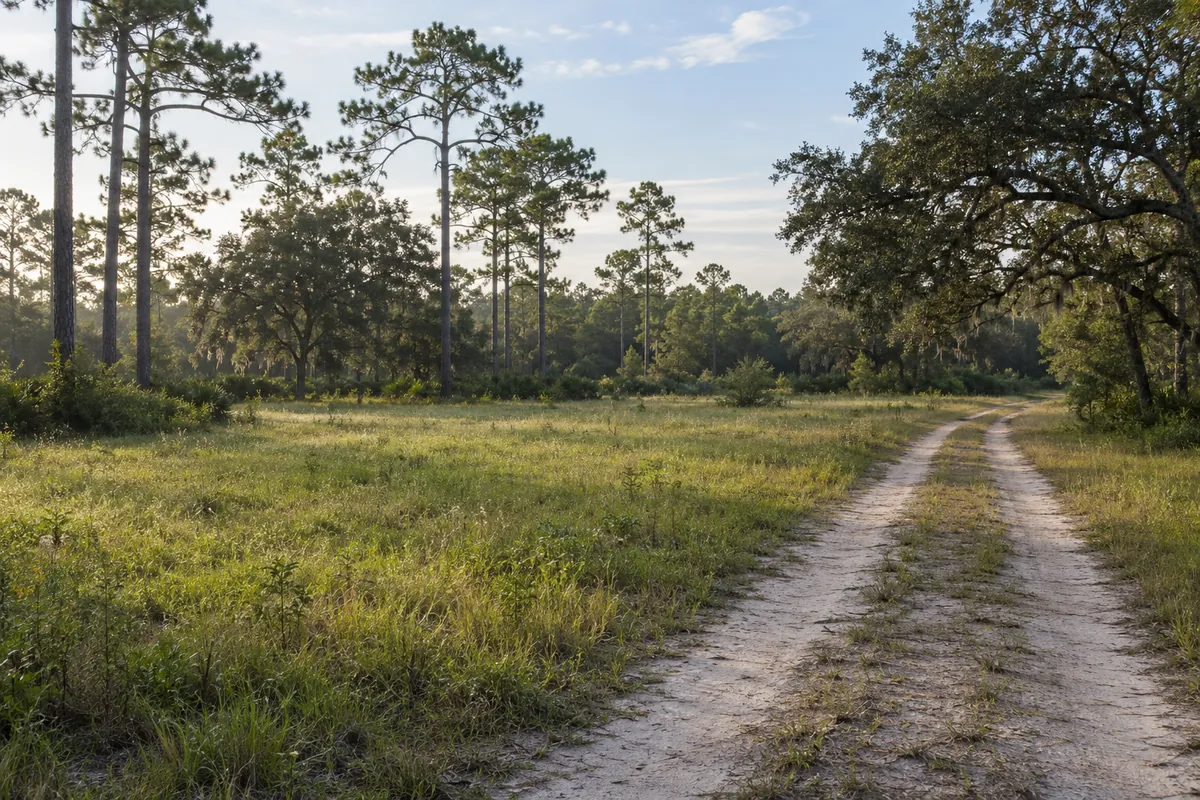
For example, a small cleared lot beside an established road may be a poor match for a large wooded tract reached by a sandy lane. A property sold with a home is also a poor bare-land match. Write down the differences instead of guessing a fixed price bonus for each acre.
Take recent photos if you can safely visit. Show the entrance and the ground farther in. A dry roadside photo does not show how the whole tract looks after rain. Keep any older photo’s date with your notes.
If a buyer wants to build, explain what you know and what is still unchecked. Do not assume a neighboring home proves that your land has the same water, septic, utility or access options.
Make a Short Comparison Sheet
For each useful sale, save the source link or report number. Add the sale date, parcel numbers, acres, full price and any buildings. Then write one sentence about how it differs from your land.
Do not average a high-priced property with a house into a vacant-land price. Check each example before deciding that a small number of acres makes it a useful lot sale. A different town label or listing date also does not prove a separate deal.
Count the same sale once, even if it appears on several websites. A new listing date or price change doesn't mean the land sold again. Several parcel numbers in one report don't automatically mean several separate sales.
Here's a made-up example of price-per-acre math:
- 20 acres sold for $80,000: $4,000 per acre.
- 40 acres sold for $120,000: $3,000 per acre.
- 5 acres with a cabin sold for $90,000: don't treat the whole $18,000 per acre as a land-only price.
These numbers aren't Liberty County sales or an estimate for your property. They show why you should check what a price includes. Don't multiply the highest per-acre figure by your acres and stop there.
Use the closest matches to discuss a range. If the records are thin or mixed, say so. A local land agent or appraiser may help find better comparisons. Our land value guide explains other details that can affect a buyer's price.
Compare What You Would Keep
Once you have a range, choose how you want to sell. An agent can help price and market the land. Selling yourself means handling the listing, questions and offers. A direct buyer can give you an offer to compare. Look at the work, time and costs of each choice.
Ask for the price and terms in writing. Check who pays closing costs, any agent fee, the planned date and what lets the buyer cancel. Ask how loans or unpaid taxes would be handled.
For a current tax balance, ask the Tax Collector’s office at 850-643-2442. Its guide says to contact the office for an exact overdue-tax payoff because the amount can change. A tax value, a tax balance and a buyer’s price are different numbers. Have the closing professional confirm what would be paid from your sale.
For a simple made-up example, a $60,000 offer minus $4,000 in seller costs leaves $56,000 before any loan or unpaid taxes. A higher offer with more costs may leave less. Use our offer comparison worksheet to put the choices side by side.
Want a direct offer to compare? You can tell Reelvest about your land. Start with what you know. You decide whether an offer fits your plans. For more selling steps, read our Florida land seller guide.
Questions About Liberty County Land Value
What is the average land price in Liberty County?
Compare recent completed sales of land like yours. We do not give a current county average here because distinct land-only sales have not been verified. Acres, ground, access and buildings affect which examples fit.
Where do I find a deed for a reported sale?
Use the Clerk’s records search page and choose Official Records. The linked search offers party name, document type, recording dates, instrument number and book/page fields. Check its verified-through date for a recent transfer.
Does a missing online deed mean the land did not sell?
Not necessarily. Check the search details and the instruments-verified-through date. Ask the Clerk at 850-643-2215 if you cannot find a recent or older record.
Is a tax certificate amount a land sale price?
No. The Tax Collector explains that a tax certificate is a claim for unpaid taxes, not a purchase of the property. Keep it out of your list of completed land-sale prices.
Does one parcel number always mean one separate sale?
No. One deal can include several pieces of land. Keep the full price and all included parcel numbers together, and count the deal once.
Is my tax value the same as an offer?
No. The Appraiser’s assessment is used for taxes. A tax balance is money owed. A buyer’s offer is the price and terms they propose. Keep those figures separate when comparing the money you would receive.
Can I ask about an offer before I find every paper?
Yes. Start with the location, acres if known and any land number, tax bill or deed you have. Explain what is missing. Ownership and signatures still need checking before a sale closes.
Local source links reviewed October 7, 2026.